
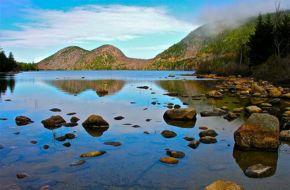
 In the famous words of Wallace Stegner, “national parks are the best idea we ever had. Absolutely American, absolutely democratic, they reflect us at our best rather than our worst.” But are National Parks truly “democratic”? Who has access to National Parks and what kinds of fantasies do they serve? This interactive program explores the history of U.S. National Parks—as myths, symbols of democratic ideals, and colonial spaces—alongside today’s common National Park activities. Why are visitation rates on the rise? What are we seeking at the National Parks? What do our National Park consumption habits tell us about ourselves? We will look at the rising phenomenon of “selfie deaths,” as well as the broader role of social media in National Park consumption. National Parks may represent freedom for some, but no matter how carefully tended and regulated, they also form part of a planet in crisis. How does climate change fundamentally threaten National Parks, challenging their status as highly valued spaces? How might we revise the preservation tradition that gave birth to the National Parks to include our own neighborhoods and communities? We will consider these questions in the national context, but also in light of our own state—home to the White Mountain National Forest, which attracts so many eager visitors every year.
This program is made possible by a New Hampshire Humanities grant, and presented in collaboration with the Friends of the Kimball Library and Atkinson Recreation.
Presenter, Abby Goode, is the author of Agrotopias: An American Literary History of Sustainability (UNC Press, 2022). As an English professor at Plymouth State, Dr. Goode teaches courses in American literature, critical theory, wilderness literature, writing and sustainability, and American food issues. She is a recipient of Plymouth State’s Transformative Teaching Award and Distinguished Scholarship Award.